


Rapid Mental Health Response for Colorado Youth
 Rapid Mental Health Response for Colorado Youth
Good afternoon, Members of the Committee. I’m Vincent
Atchity, President and CEO of Mental Health Colorado. Mental Health Colorado is
a non-profit organization working to achieve healthier minds across the
lifespan for all Coloradans. Since 1953, we have represented consumer interests
in our efforts to promote well-being, increase access to quality care and
services, and end the shame and discrimination persistently associated with
mental health and substance use conditions.
Mental Health Colorado fully supports HB21-1258 and a Rapid
Mental Health Response for Colorado Youth. We know that early intervention is
highly effective in promoting good health outcomes.
Many children are facing the steepest climb of their lives
as we try as a state to come up out of this. They will not all be able to
thrive with their peers who’ve experienced greater fortune if we do not act
now, with all our intelligence and love, to bring every player on our team
along.
Some children have done better than others during prolonged
periods of remote education. Some children have had the support and
encouragement of stably employed parents who were able to work from homes where
a productive routine could be maintained. Some have benefited from teachers who
excelled at adapting to remote learning.
But those who have managed to thrive through all of this are
not enough. Just some of Colorado’s children…is not enough.
Right now is the time to focus our intelligent efforts and
resources on identifying the young people who are facing the hardest
challenges. We know who many of them are already. And we definitely know what
they have experienced since March of 2020. While many of our children have
mercifully been spared the worst of the pandemic, there are brave and heroic Colorado children
whose parents became unemployed due to the economic shutdown. There are heroic
Colorado children who have lost the support of family financial stability, who
have lost their homes. And there are heroic Colorado children who have lost the
lives of their parents and grandparents, and their aunts and uncles. The brave
and heroic children of Colorado need the support of their big team as they face
the challenges of the months ahead.
We Coloradans pride ourselves on our wealth and resources,
on our intelligence.Colorado should not have to rank in the bottom third of the
nation for mental health needs versus access to care.
Most of us have children in our lives. As we
implement this, we will be able to make it known to them that we are vigilant
for their well-being, that we need them to be well, and that we, as a state, are
investing in them with urgency.
We are grateful to the bipartisan bill sponsors, Representatives Dafna Michaelson Jenet (D)
and Kevin Van Winkle (R), and Senators Janet Buckner (D) and Rob Woodward (R)
for recognizing that now is the time and for issuing this call to action. And
we are grateful to the Colorado Department of Human Services Office of
Behavioral Health for expediting a plan for implementing this statewide crisis
intervention for Colorado’s children. And we will celebrate the brigade of
professional care providers who will step into this next breach in our pandemic
defense effort for the sake of our children, and dedicate the extra hours in
the day it may take to ensure that we are properly safeguarding the most
valuable and essential assets we have as a community of humans.
Thank you for your support of this bill and of a strong
recovery for all Colorado’s children.


#tbt - Some favorite moments...in Rome with Granddaughter Meggie Rome Film Festival (2011)
 |
| Rome Film Festival Ken Atchity with Rupert Everett and Meggie McKenna |


World Class Performer: Short Life Lessons From Ken Atchity

Ken Atchity is a producer, author and columnist, book reviewer, brand consultant, and professor of comparative literature. He is the owner of Story Merchant, a strategic career consulting for writers and Hollywood liaison for out-of-Hollywood production companies. Atchity’s goal is to take our storyteller clients from ambition and vision to professional success in all media.
Where did you grow up and what was your childhood like? Did you have any particular experiences/stories that shaped your adult life?
I grew up between Louisiana and Kansas City, among joke-tellers and story-tellers; was educated by Jesuits in high school and college that taught me an insatiable love of learning, the discipline that provides a lifetime infrastructure for achievement, and ‘ad astra per aspera’, to the stars through obstacles—that taught me to set my aspirations high because you’ll never test your limits without exceeding them
My grandfather, an immigrant from Lebanon, always told me: “Honey, in this country there’s no penalty for failure!” I learned wisdom from him and cooking from my grandmothers, Cajun and Lebanese
What is something you wish you would’ve realized earlier in your life?
I wish I’d always had more confidence in myself.
I wish I’d congratulated myself more. Only in the last ten years have I learned to say, “Nice shot, Ken.” I spent too many years beating myself up.
That change is good. Life is change.
That it was okay to be tired. I used to think being tired was the end of the world, and that I couldn’t function when I’m tired. I felt liberated when I realized, it’s okay to be tired. You can still move forward.
Once you’ve gotten through enough ‘dark nights of the soul,’ I finally came to realize you will get through this one too.
I also learned that, instead of tossing and turning with dark and disturbing thoughts, just get out of bed and do something to move the ball forward.
You don’t have time to agonize if you’re busy.
What are bad recommendations you hear in your profession or area of expertise?
“You only get one shot.” Patently ridiculous. You get exactly as many shots as you’re willing to take. I once heard a guru answer a follower’s question, “But, master, how many times can I pick myself up?” with: “Sister, you how many times can you fall?
You’re only as good as you’re last project. Nonsense: You’re only as good as your next project.
Tell me about one of the darker periods you’ve experienced in life. How you came out of it and what you learned from it?
Time after time, especially in changing careers from being a tenured professor to being an entertainment entrepreneur (focusing on acquiring, developing, marketing, selling, publishing, and producing stories, including blockbuster movies like The Meg and nearly 20 New York Times Bestsellers like Meg, The Kennedy Detail, and Dracula: The Un-Dead), I’ve painted myself into corners from which continuing until you succeed is the only way out. Instead of dreading them, I’ve learned to love corners.
What is one thing that you do that you feel has been the biggest contributor to your success so far?
Persistence.
Doing more, and thinking less.
“Not minding what happens,” to quote Eckart Tolle.
Doing what I LOVE.
What is your morning routine?
I get up at 4 or 5, making sure I’m there to greet the sun.
I spent an hour reading and sipping coffee.
I make sure I write at least two hours every day, preferably in the a.m.
What habit or behavior that you have pursued for a few years has most improved your life?
As soon as I get up in the morning, I think about what I can look forward to throughout the day or at least in the evening.
If there isn’t anything, I immediately plan something to look forward to: dinner out, a walk, a postponed errand.
Then I proceed into the day’s challenges, knowing I’ve got something to look forward to.
What are your strategies for being productive and using your time most efficiently?
Although I’ve written books about time-management (like A Writer’s Time and How to Quit Your Day Job and Live Out Your Dreams), the most important thing I’ve learned and teach is that the best way to “find more time” is to stealit. How? By using a stopwatch (or several of them) and promising yourself you won’t end the day without putting at least an hour, say, or more or less you’re your most important projects not on the wall clock, or your wristwatch, but on a stopwatch which you turn ON when you’re working on the project and turn OFF when you’re not.
No waiting! Waiting is my least favorite thing to do, so I make sure I’m NEVER waiting. When a particular project is in someone else’s court so I’m waiting for it, I simply turn to another project, or two, or three. So I’m always using my time to move things forward until the ball is back in my court.
What book(s) have influenced your life the most? Why?
The Odyssey by Homer—my primary personal myth is that of a man who travels the world thriving on storytelling. I learned Homeric Greek to read it in the original in Jesuit high school and return to it in my thoughts nearly every day.
Do What You Love, the Money Will Follow by Marsha Sinetar—The profound observation that doing what you love is the key to happiness, and that money will come from your determination to stick to that.
Moby Dick by Herman Melville—“To write a mighty book you must have a mighty theme.” Get to the point in your life, as soon as you can, of making only big plans once you’ve proven to yourself you can accomplish smaller plans.
Do you have any quotes you live by or think of often?
“The universe is made, not of atoms, but of stories.” — Muriel Ruksmeyer
“Before enlightenment, chop wood, carry water. After enlightenment, chop wood, carry water.” — Zen koan
“I think the only immoral thing is for a being not to live every instant of its life with the utmost intensity.” — Jose Ortega y Gasset
“There’s nothing wrong with retirement as long as it does not interfere with a man’s work.” — Benjamin Franklin
Read more World Class Performer
Happy New Year! Louis was baptized today!
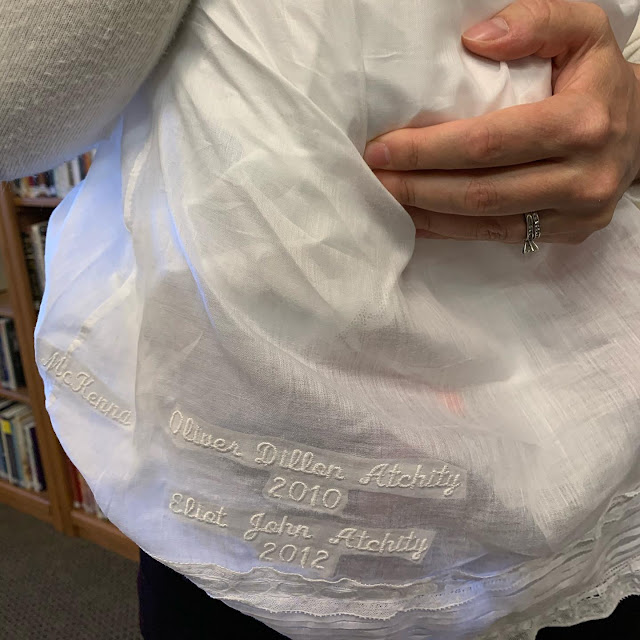
The perfect way to ring in the New Year and family friend Ronny O’Dwyer SJ was able to do the ceremony. Another miracle of the New Year- Vincent’s family heirloom outfit survived FedEx next day shipping from California. Boys can handle a bit of ribbon and lace!



OPINION: Addressing Racism is a Mental Health Imperative
by Vincent Atchity
“I love America more than any other country in the world and, exactly for this reason, I insist on the right to criticize her perpetually.”
– James Baldwin

Vincent Atchity
In July, Americans celebrate the birth of independence ― it’s the month of the national holiday when we gather and celebrate our freedom from tyrannical government. But in a country where Black, Indigenous, and People of Color are less likely to have access to mental health services and more likely to have lower quality care; in a country where Black, Indigenous, and People of Color experience discrimination and systematic alienation from Life, Liberty, and the pursuit of Happiness; in a country where we have not all been treated equally — many do not experience the freedom that has been our country’s principle source of pride.
Addressing racism is a mental health priority. For far too long, we have ignored the mental health effects of violence and systemic racism on members of our society. The systemic inequities that permeate all our lives prevent any of us from achieving healthier minds. Ignoring these inequities is a disease that destroys lives, causes the privileged to remain under-developed as humans, and threatens the vitality of the nation.
When we say that we aspire to achieve healthier minds across the lifespan for all Coloradans, we mean that we must achieve a state and a nation that isn’t like this anymore. If we’re going to have healthier minds across the lifespan for all Coloradans, we need to build a state and a nation where Black people and all People of Color don’t have to fear the police, their armed white neighbors, or that they and their descendants will be trapped forever in a system of injustice.
If we’re going to have healthier minds across the lifespan for all Coloradans, we all need to call out and correct the thinking, the manners of speech, and the behaviors that derail us from our mission. If we’re going to achieve healthier minds across the lifespan for all Coloradans, we all need to learn to be better, braver people than we have ever been before. We need a second American Revolution. We can choose to number ourselves among the revolutionaries who—with each utterance, decision, and action—join forces to free ourselves from the mind-stunting, strength-sapping twin tyrannies of proud, vaunting ignorance and smug satisfaction with the status quo. Or we can fail to rise to the challenge of this revolution and remain part of the problem, as enemies of freedom, science, and humanity. There are no innocent bystanders when it comes to the health of the mind.
Given our heartfelt understanding that Black Lives Matter, Mental Health Colorado supported a number of bills this legislative session to address or correct for disparities that have been disproportionately harmful to Colorado’s Black communities and other communities of color throughout the state’s history. There is so much more corrective work to do. We are weighted down with laws and failures in law-making that perpetuate the most disgraceful shortcomings in our still aspirational civilization.
Mental Health Colorado is following Bebe Moore Campbell’s* lead in honoring July as Black, Indigenous, and People of Color Mental Health Month. When we have ensured that all Black, Indigenous, and People of Color are free at last from systematic discrimination and oppression, when all receive the support and resources needed to truly thrive, then we will be strong and thriving and will truly have cause to celebrate.
Until then, we can celebrate that we have set our sights on the worthiest goal and that we are determined to achieve it before the sun sets on another generation.
Vincent Atchity is the president & CEO of Mental Health Colorado, the state’s leading advocate in promoting mental wellness, ending shame and discrimination, and ensuring equitable access to mental health and substance use care.
*Bebe Moore Campbell was a mental health advocate, journalist, best-selling author, and teacher. Read more about her here.

Special to the Post
The Pagosa Daily Post welcomes submissions, photos, letters and videos from people who love Pagosa Springs, Colorado. Call 970-903-2673 or email pagosadailypost@gmail.com


Happy 80th Birthday Oscar... you are missed
To celebrate what would have been his 80th birthday, Oscar’s family and friends generously shared some wonderful photos of Oscar and his extended musical family taken over the six decades of his career.
These photos will be included in Dan Donaghy's upcoming blog on Oscar’s music, VivaOscar.com.
Listen to Oscar's music on Spotify here
These photos will be included in Dan Donaghy's upcoming blog on Oscar’s music, VivaOscar.com.
Listen to Oscar's music on Spotify here
YOU:Transformed Interview: The Yoga of Giving with Kayoko Mitsumatsu
 Are you courageous enough to hand over an illustrious career to shine a light on a gaping inequality in society? Luckily Kayoko is!
We get to learn from her wisdom as the founder and executive director of Yoga Gives Back. In today's episode: How yoga positively impacted Kayoko, and her mission to help Indians through Yoga Gives Back. We talk about why you should even give money to a charity. The law of circulation, and how giving leads to more receiving, naturally. She talks about a current challenge that she is facing due to the COVID-19 situation.
You can learn more about Kayoko and Yoga Gives Back at: https://yogagivesback.org/ and https://www.instagram.com/yogagivesback/.
Voyage LA Interviews Kayoko Mitsumatsu

Kayoko, let’s start with your story. We’d love to hear how you got started and how the journey has been so far.
Prior to moving to the USA in 1992, I was a producer/director for NHK Japan’s National Public Broadcaster, working on prime-time national broadcast current affairs and documentary television programs for seven years; and cultural attaché at the Embassy of Japan in London for two years. My passion for documentary filmmaking to bridge diverse values and cultures was rooted in my perspective gained from years of living abroad including Australia, Brazil, United Kingdom and USA.
Prior to moving to the USA in 1992, I was a producer/director for NHK Japan’s National Public Broadcaster, working on prime-time national broadcast current affairs and documentary television programs for seven years; and cultural attaché at the Embassy of Japan in London for two years. My passion for documentary filmmaking to bridge diverse values and cultures was rooted in my perspective gained from years of living abroad including Australia, Brazil, United Kingdom and USA.
In 2006, I was just starting daily yoga practice for the first time while working on a documentary project about Social Entrepreneurship which opened my eyes to Nobel Peace Price Recipient Dr Muhammad Yunus’ revolutionary micro-financing. As I began to learn yoga asana and philosophy, it hit me very hard that I needed to use all my capacity to help others, especially the underserved population in India, motherland of YOGA, as I was benefiting so much from the daily practice of Yoga. I was feeling so blessed! I shared this idea with my yoga teacher and the studio manager who all supported the idea. That’s how Yoga Gives Back was born.
There were many charity organizations within the yoga community, but there was none that focused on giving back to India, especially to confront the serious issues of poverty. As we started sharing this campaign of gratitude at local fundraising classes in Los Angeles, I was surprised and inspired with passionate responses from the yoga community. I truly felt that there was a strong need in the community to express its gratitude for the gift of yoga but many of us did not know how. It was also clear that the economic imbalance was so lopsided that impoverished mothers will never even have a chance to relax with yoga practice in India, while so many of us, an estimated 300 million world wide practitioners today, enjoy this practice mainly for self-care, generating an estimated 80 billion dollars.
In the last thirteen years, Yoga Gives Back has spread to over 20 countries with 150 Ambassadors who are yoga teachers sharing YGB’s mission with their communities as well as raising funds with their events. We have also created a community of partnering sponsors whose annual contribution also tremendously support our mission.
With this growing global yoga community’s support, we are now empowering nearly 1400 women and children in India with a minimum of five-year commitment to each recipient. Today, we provide microloans to nearly 500 women and education funds to young children as well as SHE Scholarship for Higher Education for 300 youths in Karnataka and West Bengal.
Our goal is to reach to #OneMillionYogis to join our campaign so we can create much bigger impact to many more lives. Over the last decade, we have proven that we can transform so many lives if we come together at the cost of just one yoga class.
I invite everyone who benefits from the practice of yoga whether physical or spiritual, to join Yoga Gives Back!
Has it been a smooth road?
Our journey of the last thirteen years has been trial and error and I never imagined that YGB would reach to 20 countries which enables us to empower nearly 1400 lives in India. If anything, my constant challenge is the shortage of operational budget. As a founder and executive director of this grassroots nonprofit organization, I continue to manage over 90% of the entire operation. My biggest struggle is that we lack a robust marketing budget which makes it harder for us to reach out to larger audience globally. Our goal is to reach out to One Million Yogis, out of an estimated three hundred million yogis in the world, to join in our campaign to make a massive impact on many more lives in India. It is like the chicken and egg debate. If we do not invest in marketing, we can not reach out to such a wide audience. We have been growing at a slow but steady pace, and I hope we can find resources to develop a more impactful outreach strategy, as I am confident that YGB’s potential is huge. We just need more capital to fully express it.
Our journey of the last thirteen years has been trial and error and I never imagined that YGB would reach to 20 countries which enables us to empower nearly 1400 lives in India. If anything, my constant challenge is the shortage of operational budget. As a founder and executive director of this grassroots nonprofit organization, I continue to manage over 90% of the entire operation. My biggest struggle is that we lack a robust marketing budget which makes it harder for us to reach out to larger audience globally. Our goal is to reach out to One Million Yogis, out of an estimated three hundred million yogis in the world, to join in our campaign to make a massive impact on many more lives in India. It is like the chicken and egg debate. If we do not invest in marketing, we can not reach out to such a wide audience. We have been growing at a slow but steady pace, and I hope we can find resources to develop a more impactful outreach strategy, as I am confident that YGB’s potential is huge. We just need more capital to fully express it.
So, as you know, we’re impressed with Yoga Gives Back – tell our readers more, for example what you’re most proud of and what sets you apart from others.
Yoga Gives Back (YGB) is a Los Angeles based nonprofit organization, which engages global yoga communities with their personal feelings of gratitude to give back to Mother India, for the gift of yoga. We raise awareness and funds to empower underserved women and children in India. YGB is unique in uniting all yoga practitioners regardless of branch or school with one simple cause, GRATITUDE. I am proud that we have been able to reach out to yoga communities in so many countries which support nearly 1400 underserved women and children in India with microloans and education funds.
Yoga Gives Back (YGB) is a Los Angeles based nonprofit organization, which engages global yoga communities with their personal feelings of gratitude to give back to Mother India, for the gift of yoga. We raise awareness and funds to empower underserved women and children in India. YGB is unique in uniting all yoga practitioners regardless of branch or school with one simple cause, GRATITUDE. I am proud that we have been able to reach out to yoga communities in so many countries which support nearly 1400 underserved women and children in India with microloans and education funds.
YGB is also unique in connecting our global supporters directly to the fund recipients in India through regular updates of stories with photos and videos on social media and regular newsletters, so global supporters can see how everyone’s contributions are truly making tremendous difference in our recipients’ lives. We also have dozens of short documentary YGB FILMS which I have been filming and producing since 2007 to share how so many lives have been transformed with their dreams coming true. I am proud of Yoga Gives Back as it is the only charity within the global yoga community which focuses on giving back to India and empowering lives with our gratitude. We also empower ourselves by empowering others – that is a truly wonderful lesson.
I would like to add also that YGB holds Los Angeles Headquarters’ Annual Gala every fall as the main fundraising and community event, hosted generously by Glo (aka YogaGlo). We are proud to have presented our annual Namaste Awards personally to Mallika Chopra, David Lynch, Alanis Morrisette, Primal Shah, and The Pad Project, the Oscar-winning team of the short documentary “Period End of Sentence.” We are excited to present this humanitarian award to Jack Kornfield and Trudy Goodman this fall, Sunday, September 13th. Please save the date. This special event is also a testament how YGB has been able to unite diverse local yoga communities with one simple mission of gratitude – and this mission keeps growing.
Let’s touch on your thoughts about our city – what do you like the most and least?
I love Los Angeles for its diversity and the spirit of entrepreneurship. YGB was able to grow from Los Angeles to a global campaign thanks to tremendous energy and spirit of entrepreneurship in the community which accepts new ideas and supports it regardless of where you are from, how old you are, or what your background is. I was truly struck by the positive response YGB had received in the first years. People simply expressed that it was a great idea and started supporting it, which I truly appreciated it. Los Angeles is also very special for a yoga practitioner, as it is a global yoga mecca with so many pioneering and leading teachers whether asana or spiritual practices. I always feel Los Angeles has a very special energy as here is where Vivikananda and Yogananda seeded YOGA for the West. It is truly a special place in the history of YOGA.
I love Los Angeles for its diversity and the spirit of entrepreneurship. YGB was able to grow from Los Angeles to a global campaign thanks to tremendous energy and spirit of entrepreneurship in the community which accepts new ideas and supports it regardless of where you are from, how old you are, or what your background is. I was truly struck by the positive response YGB had received in the first years. People simply expressed that it was a great idea and started supporting it, which I truly appreciated it. Los Angeles is also very special for a yoga practitioner, as it is a global yoga mecca with so many pioneering and leading teachers whether asana or spiritual practices. I always feel Los Angeles has a very special energy as here is where Vivikananda and Yogananda seeded YOGA for the West. It is truly a special place in the history of YOGA.
What I like least is the lack of public transportation, which is slowly improving.
- $5 a month can provide education materials for 12 young students
- $15 a month can offer higher education for 1 teen student
- $100 a month can offer a caring home and education for 2 orphaned children


Subscribe to:
Posts (Atom)